
Designing UX for AI Products
A guide to designing AI experiences that balance human understanding, machine intelligence, and trust.
Observation
Most AI products still feel experimental. They often reveal powerful technology inside uncertain design. The algorithms are advanced, yet the user experience feels unpredictable.
This happens because we continue to apply the same mental model we use for software that obeys direct commands. Traditional design creates predictable cause and effect. AI creates probability.
When users type a prompt, the system interprets, guesses, and learns. Its logic is invisible. Its reasoning is unclear.
The result: impressive capability with uneven confidence.
When intelligence enters a product, the designer’s role shifts from controlling outcomes to clarifying behavior.
Our responsibility is no longer to simplify what is complex, but to make complexity understandable.
Example
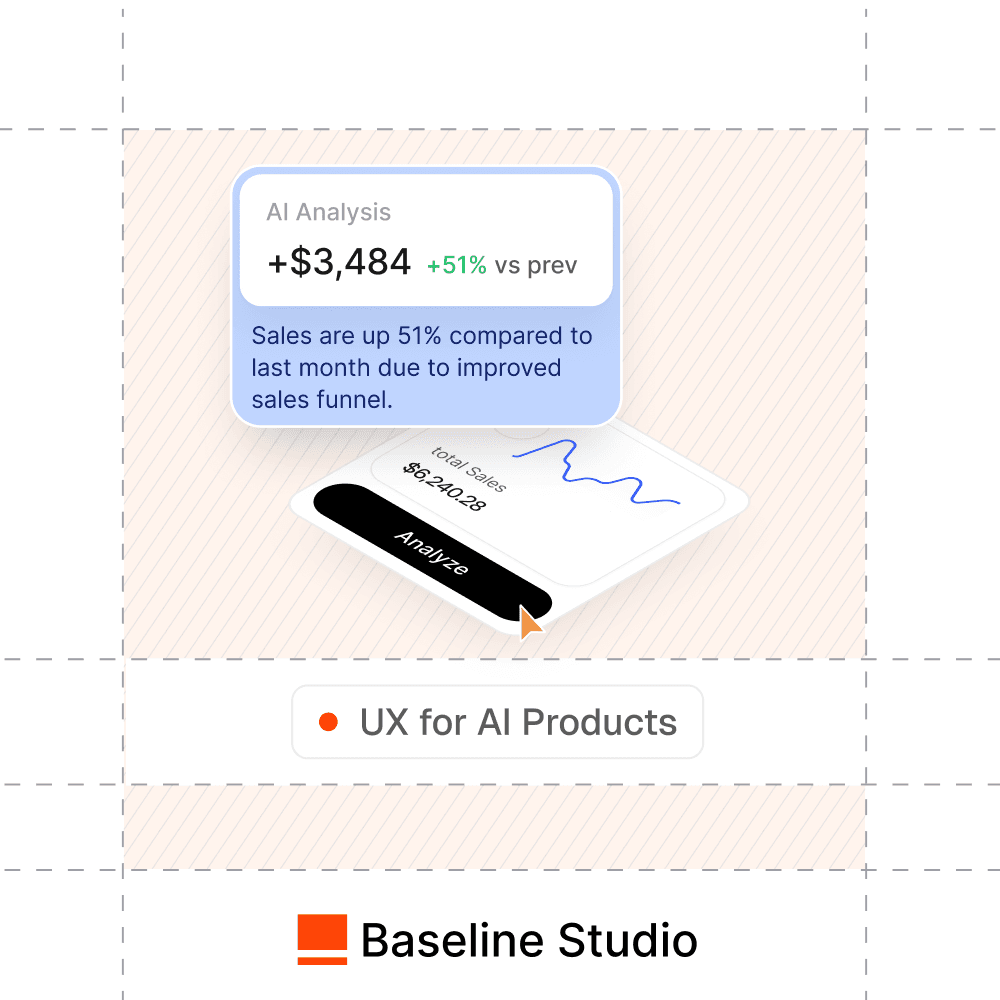
Imagine an AI assistant inside a design platform. It suggests headlines, adjusts tone, and recommends layouts.
The interaction feels simple: a user asks, the system replies. But the real experience lives in the details between those two moments.
How confident is the system in its answer?
Why did it prioritize this result?
Can I correct it or guide it next time?
When the product does not answer these questions, users lose trust. They stop collaborating with the AI and start defending against it.
A good AI experience should feel like teamwork.
The system supports intention, learns from feedback, and stays transparent about what it can and cannot do.
Reasoning
Designing for AI requires clarity about what intelligence means in practice. It is not about creating magic. It is about designing systems that explain themselves.
Traditional UX design optimizes for correctness. AI design optimizes for understanding.
Users no longer need perfect results. They need predictable behavior, transparent reasoning, and clear boundaries.
This shift can be guided by three principles: clarity, trust, and control.
1. Clarity
Clarity turns invisible logic into visible reasoning. It shows what the AI is doing, not just what it produces.
Interfaces that communicate reasoning earn credibility. Even a simple message like “based on your last edits” helps users connect action to outcome.
Designers can reveal context through:
Confidence indicators showing how sure the system is.
Alternative options that expose multiple possible outcomes.
Annotations that describe how the AI reached a decision.
Clarity also includes visual differentiation between AI-generated and human-created content. Users must understand which elements are authored by the system and which are original. (UXness)
This transparency helps the product feel intelligent without being opaque.
2. Trust
Trust is built through consistency, not perfection.
AI systems are probabilistic, which means they will sometimes fail. The way they fail determines whether users stay engaged or lose confidence.
An AI that admits uncertainty is more trustworthy than one that hides it. (IBM) Phrases like “I am unsure” or “This may not apply” communicate integrity. When the system explains why it made a choice, users start to trust its process even when they disagree with the outcome.
Trust also develops over time. Each accurate suggestion or transparent explanation strengthens the relationship.
Good design makes these proof points visible — highlighting small moments that reinforce reliability.
Avoid anthropomorphizing the system. (Microsoft)
When AI pretends to be human, it overpromises understanding and sets unrealistic expectations. Users do not need personality. They need predictability.
3. Control
Control defines the boundary between automation and agency.
The goal of AI design is not to remove human decision-making but to enhance it.
Every intelligent feature should include a path to correction. Let users refine, reverse, or teach. A good AI product makes iteration effortless.
Microsoft’s Copilot guidelines emphasize the same point: the human must always remain in control. Designers should build safety layers that allow users to adjust or dismiss results easily.
Control also relates to feedback loops.
When users interact, the system learns. When the system responds, users learn in return. (Medium AI Design Principles)
This mutual adaptation turns the experience into a living collaboration, not a one-sided conversation.
Expanding the Frame
AI is not a feature. It is a behavioral layer that influences how products think, respond, and evolve.
Many teams design AI the way they would design a button or a search bar. But intelligence reshapes the rhythm of interaction. It introduces emotion, uncertainty, and iteration into the workflow.
To design well for AI, we must understand the full context:
How does the system change the user’s sense of control?
When does it lead, and when should it wait?
How transparent is the decision process?
Who else might be affected by its actions?
Ethical design begins with awareness of indirect stakeholders. (Microsoft) AI outputs often affect people who never interact with the product directly. Design must consider that extended impact.
The Nielsen Norman Group reminds us that AI should augment, not replace, human capability. Products should empower the user, not remove them from the process.
Finally, design must account for data itself. (UX Studio)
Before automating, define the purpose:
What problem are we solving?
What data is required to solve it?
What are the risks of collecting it?
When AI design starts with intent and ends with understanding, the product serves both the user and the system honestly.
Closing Thought
AI gives us an opportunity to return to the roots of good design: empathy, clarity, and structure.
The tools may be new, but the values are not.
Our task is to translate intelligence into understanding, to make systems transparent enough that users can trust them, and to give people control even when the product can think for itself.
The future of UX will not be defined by how smart our products become, but by how clearly we help users understand them.
Next Article: